Flower sprites
The Adventures of Maya the BeeFlower sprites are short-lived, luminous beings whose lives connect a freely chosen act of generosity with death and renewal. The sprite Maya meets in an iris is at once a figure of beauty and the bearer of a precise natural law: he has only seven nights, must leave his flower to grant another creature’s dearest wish, and will eventually return to life through the plants that absorb him. His encounter with Maya makes that cycle intimate without diminishing its mystery.
Appearance and First Encounter
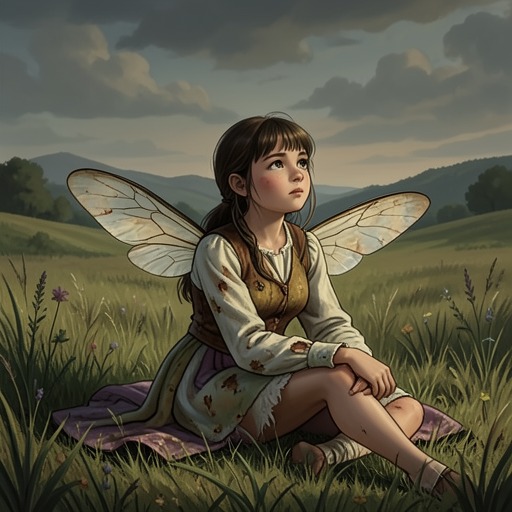
The sprite’s entrance begins with a song from an iris beside Maya, a sound unlike any she has heard. As the blossom sways, a tiny white hand grips its rim, followed by a small blond head and a delicate body clothed in white. The emergence is gradual: Maya first sees a hand, then a face and figure, as if a miniature human being is rising from the flower. The sprite climbs to the edge of the blossom, lifts his arms toward the moonlight, and smiles. A quiver passes through his body; wings unfold from his shoulders, white as the surrounding moonlight and extending from above his head to his feet.
The sight overwhelms Maya. She sits rigid, and later admits that the sprite’s beauty may be why she is crying. Her first guess is that he must be an angel, but he corrects her: he is a flower sprite. The distinction matters to the scene’s account of wonder. The sprite is not presented as an all-powerful heavenly being; he belongs to the flowers and meadow, and his extraordinary appearance is bound to a limited life and a particular duty. His song, luminous body, and wings make him seem otherworldly, while his own explanation locates him within the natural world.
Brief Life and the Choice to Leave
The sprite explains that flower sprites live for seven nights and must remain in the flower where they were born; if they leave it, they die at dawn. When Maya understands the danger, she urges him to hurry back. He tells her it is already too late, then explains why sprites nevertheless choose to depart. Before dying, each can fulfill the dearest wish of the first creature it meets. Their wings grow when they seriously decide to leave the flower for the purpose of making someone happy.
The rule makes the wings more than a mark of beauty: their appearance registers a decision and its cost. The sprite’s flight away from the iris is not described as an accidental escape or a means of preserving himself. It is a chosen movement toward another being, with a wish to be granted as its purpose and death as its consequence. The account also gives the power a limit. It concerns the first creature met and that creature’s dearest wish, rather than an unrestricted ability to grant whatever anyone might ask.
Maya does not realize that she is the first creature the sprite has encountered on leaving his flower. Instead, she responds to his explanation by saying that she, too, would leave a flower to make someone happy, and wonders whether he must die. Her readiness to admire the act comes before recognition of her place within it. The scene thus gives the reader a clear account of the sprite’s rule while leaving Maya unaware of the connection between that rule and their meeting.
Death and Renewal
The sprite describes a death that is neither painless immortality nor simple extinction. He lives to see the dawn; when dew falls, the sprites are drawn into fine, cobweb-like veils floating above meadow flowers and grass. Their wings and garments account for the veils’ white, illuminated appearance. As the light rises, they change into dewdrops. Plants drink them, and they become part of the plants’ growing and blooming, eventually rising again as sprites from flowers.
This cycle joins the sprite’s individual fate to the life of the meadow. His body does not remain separate from the world after death: it passes into dew, then into plant growth, and finally into another flowering birth. Renewal is therefore described through a sequence of transformations rather than as a return unchanged. Maya listens with intense interest and asks whether the sprite was once another sprite; his earnest eyes affirm that he was. That confirmation makes the cycle personal as well as general: his present life follows an earlier sprite’s life, and the same process promises continuation beyond his own brief span.
Encounter with Maya and Narrative Role
Before explaining the sprites’ life, the sprite asks why Maya is alone in the meadow so late. She tells him what she has done, what she knows, and what she longs for. He listens with his eyes on her, then strokes her head and regards her warmly. Maya is so joyful that she lowers her gaze. Their exchange is brief, but it shifts her position from the observer of a strange creature to someone receiving close attention and an explanation of a world she had not known.
Maya’s urgency and the sprite’s calm acceptance give the encounter its emotional contrast. She asks him to return to the iris once she understands that he may die; he answers that it is too late, but continues to speak. His composure does not erase the danger or make the choice casual. Instead, he turns the remaining conversation toward the rule governing his departure and the cycle that follows death. The scene’s wonder rests on this conjunction: an exquisite figure is also subject to a fixed lifespan, and his wings appear only as he chooses to spend that life for another.
The sprite’s account also develops the book’s attention to how creatures interpret the natural world. A floating white veil above the grass, which might otherwise remain an unexplained sight, becomes part of the sprites’ passage into dew and plant life. His explanation does not separate beauty from material change: wings and garments become dewdrops, and dewdrops nourish growing flowers. Through the sprite, Maya encounters a nature that is not merely scenery but a connected process of birth, giving, death, and renewal.